



Detroit hosts some of the most competitive trade show floors in the Midwest. The North American International Auto Show, manufacturing and industrial expos at Huntington Place, healthcare industry conferences, construction trade shows, and dozens of regional B2B events pack exhibitors into exhibit halls where every booth is competing for the same limited attention. The companies that draw crowds at these shows are not necessarily the ones with the biggest budgets. They are the ones who understand what draws attention in that environment and build their booth around it.
The Detroit Trade Show Landscape
Major Detroit-area trade shows operate across several venues. Huntington Place is the flagship convention facility downtown, hosting the largest events including the auto show and major manufacturing expositions. Suburban Collection Showplace in Novi is the primary suburban venue for mid-size shows and consumer expos. The Suburban Showplace and conference centers in Troy, Southfield, and Dearborn host smaller industry events throughout the year.
The competitive context varies by show. At the NAIAS and major manufacturing expos, exhibitors are spending six and seven figures on custom-built exhibits. At regional B2B shows and industry conferences, the typical exhibitor is working with a portable display and a $5,000 to $25,000 total booth budget. The strategies in this guide are aimed at that second category: the companies that need to draw crowds without a custom exhibit house on retainer.
What Draws People Into a Booth
Attendees at trade shows make decisions about which booths to approach in three seconds or less as they walk the aisle. In those three seconds, they are responding to two things: visual contrast and message clarity. Visual contrast means the booth looks different from its neighbors — a dark background in a sea of white booths, a backlit display in an otherwise dim section of the hall, a structural element that rises above the standard backwall height. Message clarity means a passing attendee can read and understand your primary message without stopping.
Most booths fail on message clarity. They present company names, product images, taglines, and bullet-pointed features simultaneously, competing with each other for attention. The result is visual noise that reads as “busy” from the aisle and prompts passersby to move on. The most effective trade show booths have a single clear headline; one thing that answers “why should I stop here?” at a size and position readable from 20 to 30 feet away.
Display Ideas That Draw Crowds
The Backlit Fabric Backwall
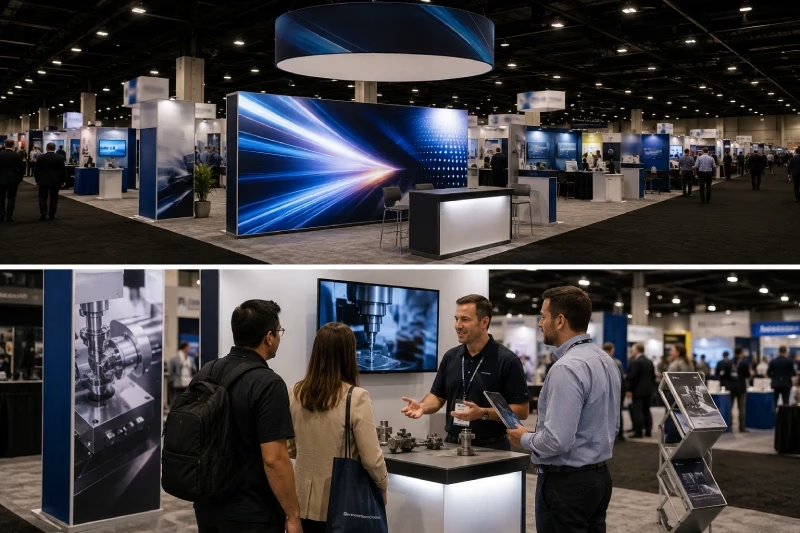
A backlit tension fabric display creates a fundamentally different visual presence than a non-backlit display. In the typically dim environment of a large exhibit hall, a backlit display is a light source. It draws the eye from a distance the way a lit window draws attention in a dark street. The graphic itself appears more vivid, the colors are richer, and the overall impression is premium in a way that immediately distinguishes the booth from its neighbors.
For most 10×10 and 10×20 inline booths, a backlit tension fabric backwall is the single highest-impact display upgrade available. The cost premium over a standard non-backlit backwall is $300 to $800 depending on the frame size. At any Detroit trade show where the hall is even partially dim, that investment directly translates to more booth traffic.
Using Vertical Space: Hanging Signs and Overhead Displays
Standard booth backwalls top out at 8 to 10 feet. At a show with hundreds of booths on a large floor, every booth looks identical in height, a continuous horizon line of backwalls at 8 to 10 feet. Any element that breaks above that line is immediately visible from a distance. Hanging signs accomplish exactly this. A 4-foot hanging sign above a 10×20 booth is visible from 50 to 100 feet away depending on the hall configuration.
Huntington Place permits hanging signs in the large exhibit halls, though there are ceiling height minimums and rigging fees charged by the official show contractor. Confirm hanging sign rules in the exhibitor services kit before planning any overhead display. Where hanging signs are permitted, even a simple hanging sign with your company name and primary message dramatically increases booth findability.
Dimensional and 3D Elements
Dimensional elements add physical depth that flat graphics cannot provide. They also photograph better, which matters for social media coverage during and after the show. A branded product display counter in the front of the booth creates a natural interaction point and breaks the flat plane of the backwall. Dimensional letters mounted on the backwall face add depth that reads as premium and intentional.
Interactive Demo Zones
Booths that offer something to do draw more visitors than booths that offer something to look at. A product demonstration, a touchscreen interaction, a sample, or even a well-placed video screen creates a reason to stop rather than a reason to glance. The signage supporting a demo zone should frame the activity without competing with it, like a clean overhead banner naming the demo, a counter-height sign with the key point the demo is illustrating, and a call to action sign at the exit point of the interaction.
Booth Layout Strategies by Size
10×10 Inline Booth
The 10×10 inline booth is the most common format at Detroit B2B shows. The effective strategy is a single backwall (tension fabric, backlit if budget allows), one or two retractable banner stands at the front corners to extend the visual footprint into the aisle, and a display table with a printed table throw. The most important rule: one headline on the back wall, large enough to read from the aisle. Everything else is secondary.
10×20 Inline Booth
A 10×20 booth can be divided into two zones: a display or demo zone on one side and a conversation zone on the other. The backwall can carry two or three messages. One primary headline spanning the full width, and secondary messages in the individual zones. Corner positioning in a 10×20 end-cap booth creates two aisle faces, which doubles the approach directions and significantly increases visibility.
Island Booth
An island booth is open on all four sides and typically occupies a 20×20 or larger footprint. The island booth strategy requires 360-degree branding, since the booth must read well from every approach direction. A central structural element (a counter, a tower, a product display) anchored under a hanging sign provides a core around which the four aisle faces are designed. Single-sided displays do not work for island booths; every surface must carry the brand.
Signage Hierarchy in a Trade Show Booth
Effective trade show booth signage operates at three distance levels. The 30-foot message is the one that stops people from walking past; it needs to be your company name and a one-line description of what you do, in type large enough to read from across a crowded aisle. The 10-foot message is what engages someone who has stopped, like your key differentiator, a product name, a statistic that makes the category concrete. The 3-foot message is what closes the interaction with detailed features, like a QR code, contact information, and pricing.
Most booths get the 10-foot and 3-foot messages right and ignore the 30-foot message entirely. The backwall is covered in logos, product images, and bullet-pointed features that are legible only from within the booth. The result is a booth that looks polished from inside but draws no one in from the aisle.
Booth Impact vs. Cost
| Upgrade | Cost Range | Impact on Booth Traffic |
|---|---|---|
| Backlit vs. non-backlit backwall | +$300–$800 | High — most impactful single upgrade in dim halls |
| Printed table throw (vs. bare table) | $150–$350 | Medium — completes the branded environment |
| Second retractable banner stand | $200–$400 | Medium — extends visual footprint into aisle |
| Hanging sign (where permitted) | $400–$900 | High — visibility from 50–100 feet |
| Step-and-repeat backdrop / photo wall | $300–$700 | Medium — creates social media photo opportunity |
| Branded counter or product pedestal | $500–$1,500 | High — creates interaction point, draws engagement |
Event Signage Beyond the Booth
Sponsorship packages at Detroit trade shows and industry events often include signage placement outside the exhibitor’s own booth: banners at registration, signage on conference room doors, inclusion on event directional signs, or digital display placement in common areas. These sponsorship sign placements put your brand in front of the entire event audience, not just the portion of attendees who walk your aisle. For companies making a significant marketing investment in a Detroit show, combining a well-designed booth with strategic sponsorship signage extends the reach significantly.
Frequently Asked Questions
What is the most impactful display for a 10×10 trade show booth?
A backlit 10-foot tension fabric backwall is the highest single-unit impact display for a 10×10 inline booth at Detroit trade shows. It provides a seamless, large-format branded surface that appears as a light source in exhibit hall conditions. Paired with a printed table throw and one or two retractable banner stands at the booth corners, it creates a complete, polished presentation that reads as premium from the aisle.
Does Huntington Place allow hanging signs?
Yes, Huntington Place permits hanging signs in the main exhibit halls, subject to ceiling height minimums and rigging requirements. Rigging must be performed by the official show contractor; exhibitors cannot hang their own ceiling structures. Rigging fees are charged separately and vary by show and sign weight. Confirm the specific requirements in the exhibitor services kit for your show, as rules vary between events.
How early should I order trade show displays for a Detroit show?
Eight weeks before the show is the comfortable planning window for a first-time exhibitor. For repeat exhibitors refreshing an existing display with updated graphics, four to five weeks is workable. Backlit tension fabric displays and custom-configured systems need more lead time than standard portable displays. Rush production is available in two to three weeks at a premium but limits design revision time.
What is the biggest mistake exhibitors make at Detroit trade shows?
The most common and costly mistake is a cluttered backwall with no clear primary message. A 10×10 backwall covered with logos, product images, taglines, bullet points, and contact information communicates everything and nothing simultaneously. Attendees walking the aisle cannot process that much information in three seconds and move on. The single most impactful design decision for any booth is identifying the headline someone should stop to and making it dominate the back wall.
Can I reuse my trade show displays at multiple shows?
Yes. Retractable banner stands, tension fabric displays, and most portable display systems are designed for repeated use. Hardware from quality manufacturers outlasts dozens of shows. Graphics can be updated without replacing the hardware. Storing displays properly between shows (retractable banners fully retracted in their cases, fabric displays folded in their bags) is the key to maximizing reuse value.