



The portable trade show display market has expanded significantly in the past decade. Where exhibitors once had two or three options, they now have a dozen, and each format has a genuinely different set of strengths, weaknesses, and ideal use cases. Choosing the wrong format for your booth space and goals is an expensive mistake. This guide breaks down every major portable display type and helps you match the right format to your situation before you spend a dollar on production.
What “Portable” Actually Means in Trade Show Displays
Portability in trade show displays exists on a spectrum. At one end is carry-on portable, a retractable banner stand that fits in an airline overhead bin. At the other end is “portable compared to a custom-built exhibit”, a tension fabric display system that ships in a wheeled bag weighing 60 pounds. Both are described as portable, but they solve very different logistics problems.
Before choosing a display format, answer two questions: how does this display travel to shows, and who sets it up? A solo sales rep flying to regional shows needs something genuinely carry-on portable. A marketing team driving a company van to Huntington Place has much more flexibility. The right format depends on both.
Retractable Banner Stands
How They Work and What They Cost
A retractable banner stand, also called a roll-up banner stand, houses a spring-loaded graphic cassette inside an aluminum base. The graphic pulls up from the cassette, attaches to a support pole, and stands independently. Setup takes under two minutes. The base is typically 32 to 36 inches wide, and the graphic height runs 78 to 92 inches depending on the stand model. Economy stands start around $150 with printing. Mid-range stands with better cassette mechanisms and more stable bases run $250 to $350. Premium stands with replaceable graphic cassettes and precision mechanisms run $400 to $600.
The practical difference between economy and premium is durability over time. An economy stand works for 10 to 20 uses before the cassette spring weakens, or the base develops instability. A premium stand with a replaceable cassette effectively has an unlimited service life; you replace the graphic cassette as the messaging changes, and the base continues performing.
When Retractable Banners Are the Right Choice
Retractable banner stands are the correct choice for solo exhibitors, supplemental side-wall branding in a 10×10 booth, directional signage within larger booths, and companies that exhibit at 5 or more shows per year where portability and fast setup are primary requirements. They are also the best solution for in-office presentations, dealership floor displays, and any situation where the display needs to travel in checked luggage or a car trunk.
When They Are Not Enough
A single retractable banner stand in a 10×10 trade show booth reads as underdone; it signals that the exhibitor is making a minimal investment, which can affect how attendees perceive the company. A booth of three banner stands is better but still lacks the visual unity of a dedicated backwall system. For any company where the trade show booth is a primary business development tool, a tension fabric display system is a stronger investment.
Tension Fabric Displays: Pop-Up and Frame Systems
How Tension Fabric Displays Work
Tension fabric displays use an aluminum frame over which a dye-sublimation printed fabric graphic is stretched. The frame is typically a pop-up style (accordion-folded aluminum arms that expand into shape) or a straight or curved tube-and-connector frame system. The fabric graphic zips or clips over the frame, creating a seamless printed surface. Backlit versions add an LED light source inside the frame, which illuminates the fabric graphic from behind for a lightbox effect.
Setup time for a standard 10-foot tension fabric backwall runs 15 to 30 minutes for someone who has done it before. The entire system, frame and fabric, typically fits in a wheeled bag or case weighing 40 to 70 pounds. This is checked-luggage portable, not carry-on portable, but it ships economically and avoids crating fees at most venues.
When Tension Fabric Displays Win
A tension fabric display is the right primary backwall for any 10×10 or 10×20 inline booth where visual impact is the priority. The seamless printed surface reads as premium in a way that a row of banner stands does not. Backlit tension fabric displays, where the frame includes internal LED lighting, create a dramatically different visual presence in the typically dim environment of a large exhibit hall. For companies that exhibit at three or more shows per year and need a consistent, polished presentation, tension fabric backwalls are the standard.
Printed Step-and-Repeat Backdrops
The step-and-repeat backdrop, a large-format printed banner on a retractable or fixed frame, featuring a repeating branded pattern, has moved from event photography into mainstream B2B trade show use. In trade show applications, a step-and-repeat backdrop serves as both a photo opportunity (attendees photographed in front of it provide branded social media content) and a high-visibility brand display. The format scales well: a 6-foot backdrop is effective for tabletop events, a 10-foot backdrop dominates a standard inline booth.
For Detroit-area product launches, automotive shows, healthcare summits, and B2B conferences, step-and-repeat backdrops are an increasingly common sight at sponsorship areas, registration zones, and featured exhibitor spaces. They are fast to produce, easy to transport, and immediately recognizable as a professional brand presence.
Tabletop Displays
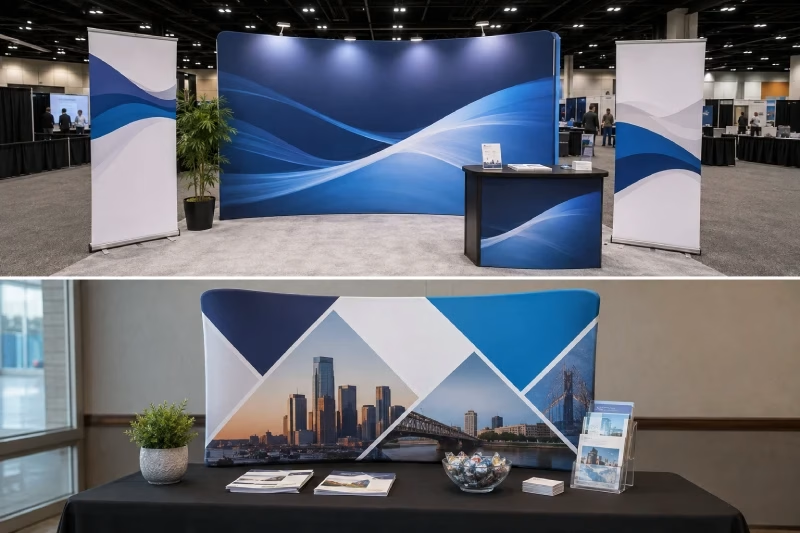
When the entire exhibit footprint is a six-foot table common at smaller industry events, chamber expos, and in-office sales presentations, a tabletop display provides a professional backdrop within the limited space. Tabletop tension fabric displays (a miniature version of the freestanding backwall), folding panel displays, and simple retractable banner stands positioned behind the table are all viable options. The most important rule for tabletop displays is visibility: the display needs to read clearly from eight to ten feet away, not just from standing directly in front of the table.
Hybrid Systems: Combining Portable Formats
The most effective portable booth setups combine formats to create a complete presentation without requiring crated freight. A standard combination for a 10×10 inline booth: one tension fabric backwall (the primary visual anchor), two retractable banner stands positioned at the front corners (extending the visual footprint), and a printed table throw on the display table (completing the branded environment from floor to tabletop). This combination ships in a wheeled bag and two banner stand cases, requires no professional installation, and creates a visually complete booth for $2,000 to $4,000.
Portable Display Format Comparison
| Format | Setup Time | Portability | Cost Range | Best For |
|---|---|---|---|---|
| Retractable banner stand | 2 min | Carry-on | $150–$600 | Supplemental, solo exhibitors |
| Tension fabric backwall | 15–30 min | Wheeled bag | $800–$2,500 | Primary backwall, 10×10/10×20 |
| Step-and-repeat backdrop | 5–10 min | Carry bag/case | $300–$800 | Photo ops, brand presence |
| Tabletop display | 5 min | Carry-on/bag | $200–$600 | Small events, table-only footprint |
| Hybrid system (combined) | 20–40 min | 2–3 cases/bags | $2,000–$4,500 | Complete 10×10 booth, polished look |
Graphic Production Quality, What Makes the Difference
The format of the display matters, but the graphic quality determines the impression. For tension fabric displays, dye-sublimation printing produces vivid, seamless color on fabric that does not pixelate at large sizes. Retractable banner stand graphics are typically printed on vinyl; 100 to 150 dpi at full size is the minimum acceptable resolution, and artwork supplied at screen resolution (72 dpi) will look soft and unprofessional at display size. Always confirm the required file specifications with your print vendor before finalizing artwork.
Ordering Portable Displays in Metro Detroit
Most portable trade show display formats can be produced and delivered in five to ten business days from art approval. Rush production (two to three business days) is available at a premium. Detroit Signs & Graphics produces all major portable display formats and can advise on the right combination for your booth space, travel logistics, and budget.
Frequently Asked Questions
What is the most durable portable trade show display?
Premium retractable banner stands with replaceable graphic cassettes from manufacturers like Expand, Expolinc, or similar professional-grade brands are the most durable portable option for frequent exhibitors; the hardware outlasts dozens of shows. For backwall systems, aluminum tube-and-connector tension fabric frames are more durable than accordion pop-up frames because individual tubes and connectors can be replaced if damaged, while pop-up frames fail as a unit when a single arm bends.
Can I replace just the graphic on a retractable banner stand?
On premium and mid-range retractable banner stands, yes, the graphic cassette is a replaceable component. Economy stands typically do not support cassette replacement; the graphic is permanently installed, and updating the message means buying a new stand. When purchasing retractable banner stands for a company that will exhibit regularly, investing in a cassette-replaceable model pays off within two or three graphic updates.
How do I transport a 10×10 tension fabric display?
Most 10-foot tension fabric backwall systems pack into one or two wheeled bags or cases specifically designed for the hardware. The fabric graphic folds into a separate bag. The total shipping weight for a standard 10-foot tension fabric backwall runs 40 to 70 pounds. This ships as standard freight or oversize checked luggage on most carriers. The cases typically fit in a cargo van or SUV without disassembly.
What size retractable banner stand is best for a trade show?
The 33-inch wide by 80-inch tall format is the most common trade show retractable banner stand size and works well for most applications. Premium stands are available in wider formats (47 inches and wider) for a more impactful single-stand presentation. For supplemental side-wall banners in a 10×10 booth, two 33-inch stands flanking a central backwall are more effective than a single wide stand.
How far in advance should I order portable trade show displays in Detroit?
Standard lead time for portable trade show displays in Detroit is five to ten business days from art approval. Planning for two weeks from the start of the design process to delivery is comfortable. For shows at Huntington Place or other major Detroit venues with firm freight deadlines, add the advance warehouse shipping deadline to your timeline; freight typically needs to arrive at the advance warehouse one to two weeks before show opening.