



When business owners hear “ADA signs,” restroom signs typically come to mind. The requirement extends significantly further. Braille and tactile sign requirements in Michigan apply to every permanently designated room in a facility open to the public, and the specific requirements for character format, Braille grade, mounting location, and surface finish are detailed enough that most generic sign purchases from online retailers do not actually comply. This post walks through exactly where Michigan businesses must install tactile and Braille signs, what those signs must include, and what the most commonly cited violations look like.
The Legal Foundation: ADA and Michigan Law
The ADA Standards for Accessible Design require tactile room identification signs that can be read by touch on all permanent rooms and spaces in facilities covered by Title II (government facilities) and Title III (places of public accommodation). The Braille grade required is Grade 2, also called contracted Braille, which is the standard Braille literacy format. This has been the requirement since the ADA became effective in 1992. Grade 1 Braille, a simpler, uncontracted form sometimes found on cheaper generic sign products, does not comply.
Michigan’s Barrier-Free Design requirements, incorporated into the Michigan Building Code, reinforce and in some cases supplement the federal ADA requirements. Michigan building permit inspections check for ADA-compliant signage as part of new construction and significant renovation approvals. Beyond the building code process, private lawsuits under the ADA are the more common compliance enforcement mechanism for existing buildings, and signage is consistently cited in accessibility audits and complaints.
What Makes a Sign “Tactile”
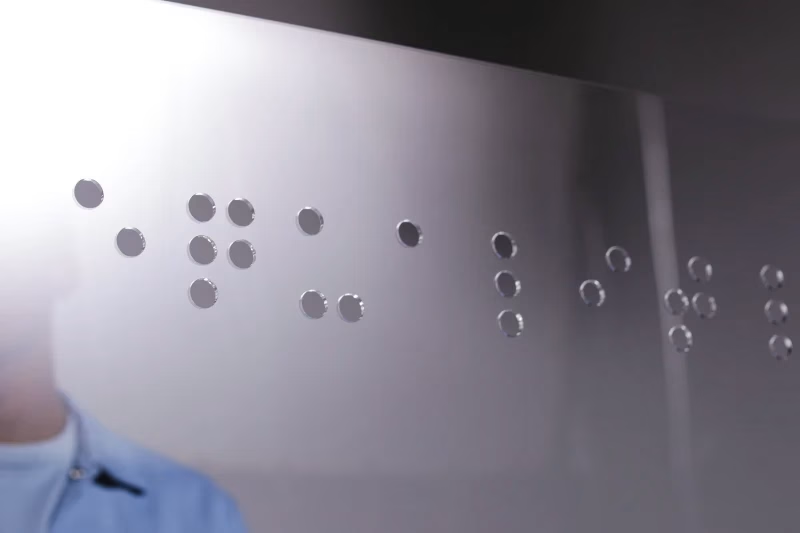
A tactile sign, in the ADA sense, is a sign with raised characters that can be read by touch. Engraved characters, letters cut into the sign surface, do not comply; the characters must protrude above the sign face. Raised characters must be between 5/8 inch and 2 inches in height, in an uppercase sans-serif font, with specific character spacing requirements. The Braille cells must be Grade 2 Braille and must be positioned directly below the corresponding text, not beside.
A common and non-compliant approach is adding a Braille label strip to the bottom of an otherwise non-compliant sign. If the sign face is gloss acrylic, the characters are engraved rather than raised, or the font is decorative or serif, adding Braille to the bottom of it does not make the sign compliant. The entire sign assembly, including the face material, character format, and mounting, must meet the standard.
Where Braille Signs Are Required in Michigan
Permanent Room Identification (Always Required)
Every restroom with a permanent designation requires a tactile and Braille sign: single-use, multi-stall, gender-neutral, and accessible restrooms all qualify. Every exit door leading to a stairwell, an area of rescue assistance, or the building exterior requires a tactile sign at the door with the appropriate designation (“Exit,” “Stair,” floor number, or area-specific text). Every conference room, break room, kitchen, storage room, utility closet, and janitor closet with a permanent function requires a compliant room ID sign.
Floor Identification at Elevator Landings
At every elevator landing, a floor identification sign is required on the wall adjacent to the elevator call button. This sign must include the floor number in raised tactile characters and Grade 2 Braille, mounted at the correct height (60 inches AFF centerline) on the latch side of any adjacent door or on the wall at the elevator lobby. The elevator cab itself has separate requirements; Braille floor buttons are an elevator code requirement, not an ADA room sign requirement, but both must be met.
Areas Where Braille Signs Are Commonly Missing
Janitor closets and utility rooms with permanent functions are required to have compliant room ID signs, but they are the most commonly omitted in building audits. The logic building managers often apply is that these rooms aren’t public-facing, so they don’t need ADA signs. This is incorrect; the requirement is based on whether the room has a permanent function, not on whether it is public-facing. Mechanical rooms, electrical rooms, and IT server rooms with permanent designations all require compliant signs.
Suite entry signs are a more nuanced area. In a multi-tenant office building, the suite entry sign identifying the tenant is not always required to be a full ADA tactile sign, but the room identification signs for the rooms within the suite are required. The distinction is between a sign identifying an area (a business name sign at a suite entrance) and a sign identifying a specific room (a conference room sign inside the suite).
What a Fully Compliant Tactile Sign Must Include
| Requirement | Specification |
|---|---|
| Character type | Raised (not engraved), uppercase only for tactile text, sans-serif font |
| Character height | Minimum 5/8 inch, maximum 2 inches above sign face |
| Braille grade | Grade 2 (contracted) Braille, positioned directly below corresponding text |
| Finish | Non-glare (matte) on both sign face and characters, no glossy acrylic |
| Contrast | Minimum 70% luminance contrast between sign background and characters |
| Character spacing | Between 1/8″ and 4x character stroke width between adjacent letters |
| Mounting height | Centerline of tactile text at 60 inches above finished floor (AFF) |
| Mounting location | Latch side of the door; if no latch side wall, nearest adjacent wall |
| Approach space | No obstruction within 3 inches of the sign on either side |
| Pictogram (restrooms) | 6-inch minimum pictogram field with verbal descriptor below in tactile text + Braille |
Mounting Requirements: The Most Commonly Violated Rule
The single most frequently cited ADA sign violation in building audits is incorrect mounting, specifically, mounting the sign on the hinge side of the door rather than the latch side. The latch side is the side of the door with the door handle; the side the door swings away from. The hinge side is where the door is attached to the frame. A sign on the hinge side does not comply, regardless of how well the sign itself is manufactured. This error is common enough that it appears in a significant percentage of older commercial buildings in metro Detroit, including buildings that have had other updates since original construction.
The 60-inch centerline height requirement is measured from the finished floor to the centerline of the tactile text, not the top of the sign, not the bottom of the Braille. If the tactile text occupies three inches of height, the sign face should be centered such that the middle of the text block is at 60 inches AFF. Signs installed at standard door hardware height (approximately 48 inches) are below compliance. Signs installed at the top of the door frame (above 66 inches) are above compliance.
What Is NOT Required to Have Braille
Not every sign in a commercial building requires tactile characters and Braille. Directional signs that provide directions or information about accessible routes are not required to have tactile characters. Menu boards, price lists, and informational signs that are not room identification signs do not require Braille. Overhead signs and hanging signs are not required to be tactile. Temporary signs, paper inserts, name tags on door holders, and dry-erase boards are not required to comply with tactile sign requirements.
Exit signs, the red or green illuminated signs over exit doors required by fire code, have their own separate requirements under NFPA 101 and are distinct from the ADA tactile exit door signs. Both may be required at the same door, but they are different signs serving different regulatory purposes.
Getting Compliant Braille Signs for Your Michigan Business
The most reliable approach to ADA sign compliance is to purchase signs from a sign company that certifies compliance with the ADA Standards for Accessible Design, rather than generic products from online retailers that may not meet Grade 2 Braille or character height requirements. Detroit Signs & Graphics produces ADA-compliant tactile and Braille signs for commercial facilities across metro Detroit. We also conduct facility sign audits, a walkthrough that identifies every non-compliant sign and produces a prioritized replacement list and a quote for compliant replacements.
Frequently Asked Questions
Does every room in a commercial building in Michigan need a Braille sign?
Every room with a permanent designation, a fixed function that doesn’t regularly change, requires an ADA-compliant tactile and Braille room identification sign in facilities subject to ADA Title II or Title III. This includes restrooms, conference rooms, break rooms, storage rooms, utility rooms, stairwells, and similar permanently designated spaces. Rooms without permanent designations and signs that are not room identification signs (directional signs, informational signs) do not require tactile characters and Braille.
What grade of Braille is required for ADA signs?
Grade 2 Braille, also called contracted Braille, is required by the ADA Standards for Accessible Design. Grade 2 Braille uses contractions and abbreviations that reduce the total number of Braille cells compared to Grade 1 (uncontracted) Braille. Generic sign products sometimes use Grade 1 Braille, which is simpler and cheaper to produce, but Grade 1 does not meet the ADA standard.
Can I add Braille to my existing signs instead of replacing them?
If the existing signs meet all other requirements-, raised uppercase sans-serif characters, non-glare finish, 70 percent luminance contrast, correct dimensions- then adding Grade 2 Braille in the correct position (directly below the tactile text) can bring them into compliance on the Braille requirement alone. However, if the signs have gloss acrylic faces, engraved rather than raised characters, or are mounted in the wrong location or at the wrong height, adding Braille alone will not achieve compliance. A professional audit is the fastest way to determine which signs can be remediated versus which need full replacement.
What happens if my Braille sign is installed on the wrong side of the door?
A sign installed on the hinge side of the door rather than the latch side does not comply with the ADA, regardless of the sign’s own quality. The sign must be relocated to the latch side, at the correct height. If the latch side wall does not have adequate clearance between the door frame and a perpendicular wall, the sign should be installed on the nearest available wall surface on the latch side at the correct mounting height.
Are home offices or small home-based businesses required to have ADA signs?
Home offices that do not receive members of the public are not places of public accommodation under ADA Title III and are not subject to ADA signage requirements. A home-based business that regularly receives clients or customers in the home may have some obligations, particularly if it employs workers with disabilities or if it is structured to serve as a public accommodation. The specific threshold requires legal evaluation based on the nature and frequency of public access.