



Most building owners and facility managers believe their ADA signage is compliant. Most are wrong, not because they ignored the rules, but because ADA signage requirements are more specific than commonly understood, and signs installed years ago may no longer meet current standards. Common violations include signs mounted on the wrong side of the door, signs at the wrong height, signs using gloss-finish acrylic that fails the non-glare requirement, and signs missing the Grade 2 Braille that the ADA has required since 1992. This self-audit takes 15 minutes and tells you where you stand before an inspector, a tenant complaint, or a lawsuit does it for you.
Why ADA Signage Compliance Matters in Michigan
The Americans with Disabilities Act applies to virtually every commercial building in Michigan. Title III covers places of public accommodation: retail stores, restaurants, hotels, professional offices, healthcare facilities, and any other facility open to the public. Title II covers state and local government facilities. Between the two titles, the requirement extends to nearly every non-residential building in the state. Michigan’s own Barrier-Free Design requirements, enforced through the Michigan Building Code, add state-level requirements that overlap with and in some cases exceed the federal ADA standards.
Non-compliance with ADA signage requirements is an actionable condition. Disability rights organizations and their attorneys routinely survey commercial buildings for ADA violations and file complaints with the Department of Justice or federal civil suits. The cost of litigation and court-ordered remediation significantly exceeds the cost of proactive compliance. Beyond the legal exposure, ADA-compliant signage is also simply the right operational standard; it serves the approximately 12 percent of Michigan adults living with a disability.
The 5 Core ADA Signage Requirements
1. Tactile Characters and Grade 2 Braille
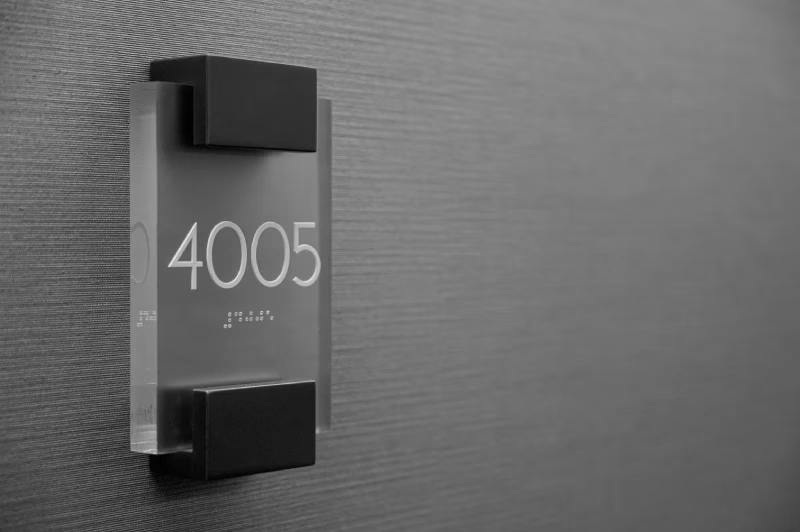
All permanent room identification signs must include raised (tactile) characters and Grade 2 Braille. This applies to every sign that identifies a specific room with a permanent designation, including restrooms, offices, conference rooms, storage rooms, stairwells, and any other space with a fixed function. Raised characters must be between 5/8 inch and 2 inches in height, must be sans-serif typeface (no serifs, no decorative fonts), and must be uppercase. Grade 2 Braille (the contracted form of Braille, not the simpler Grade 1) must be positioned directly below the raised text, not to the side.
2. Mounting Height and Location
The mounting height requirement is precise and commonly violated: the centerline of the tactile characters must be at 60 inches above the finished floor. The sign must be mounted on the latch side of the door, which should be the side the door opens away from, where the door handle is. If the latch side wall does not have space between the door frame and a perpendicular wall, the sign must be placed on the nearest adjacent wall. The sign face must be within a specific proximity to the door; the technical requirement is that the sign be centered between 18 inches and the perpendicular wall if less than 18 inches is available.
Mounting on the hinge side of the door is one of the most common ADA sign violations found in Michigan building audits. A sign on the wrong side of the door does not comply regardless of how well the sign itself is made.
3. Non-Glare Finish
The ADA requires a non-glare (matte) finish on both the sign face and the tactile characters. Glossy acrylic signs, which represent the majority of commercially purchased “ADA signs” sold online, do not meet this requirement. The contrast between the sign background and the characters must be at least 70 percent luminance contrast. Effectively, the sign background and character color must be visually very different in lightness and darkness. Dark characters on a light background, or light characters on a dark background, are both acceptable. Medium gray on light gray is not.
4. Character Format and Spacing
Tactile characters must be uppercase only (except proper nouns and common usage words that are always lowercase). Character spacing (the distance between adjacent letters) must be between 1/8 inch and 4 times the character stroke width. The font must be sans-serif: Arial, Helvetica, Futura, and similar clean typefaces comply. Times New Roman, script fonts, compressed fonts, and decorative display typefaces do not.
5. Pictograms Where Required
Pictogram fields are required on restroom signs (male, female, accessible, and gender-neutral designations) and accessible entrance signs. The pictogram field must be at least 6 inches tall, with a verbal descriptor below it in compliant raised characters and Braille. The pictogram field must have a non-glare background. If your restroom signs have only a pictogram without the verbal descriptor below it, they do not comply.
Which Rooms Always Require ADA-Compliant Signs
The ADA requires tactile room identification signs at every room that is “identified by a permanent designation.” In practice, this means:
Every restroom in the building, including single-use, multi-stall, gender-neutral, and accessible restrooms. Every exit door leading to a stairwell, exterior, or area of rescue assistance. Every room with a permanent, fixed function: conference rooms, break rooms, storage rooms, server rooms, utility closets, janitor closets, and similar spaces. Elevator lobbies at each floor (floor number signs). These must include raised characters and Braille for the floor number.
Rooms That Do NOT Require ADA Room ID Signs
Not every door in a building needs an ADA-compliant room identification sign. Rooms whose function changes frequently (open-plan spaces that serve different purposes, modular conference spaces with no fixed name) do not require permanent ADA room ID signs. Rooms identified only by a temporary nameplate or paper insert are not “permanently designated” under the ADA. Occupied spaces with no public access (executive suites in buildings where visitors never enter the private office areas) may not require full ADA compliance on every door, though restrooms in those areas always do.
The 15-Minute Self-Audit, Room by Room
| Location | What to Check | Common Violation |
|---|---|---|
| All restrooms | Tactile text, Braille, pictogram, non-glare finish, latch side, 60″ AFF | Gloss finish; wrong side of door; missing Braille |
| Exit / stairwell doors | Tactile “Stair” or floor number, Braille, 60″ AFF, latch side | Missing Braille; hinge-side mounting |
| Conference rooms | Tactile room name, Braille, non-glare, latch side, 60″ AFF | Gloss acrylic; wrong door side |
| Private offices | If permanently named/designated: tactile, Braille, compliant mounting | Often omitted entirely |
| Break room / kitchen | Tactile room name, Braille, non-glare, correct mounting | Frequently non-compliant or missing |
| Storage / utility rooms | Tactile designation, Braille required if permanent function | Often overlooked completely |
| Elevator lobbies | Floor number in tactile characters + Braille at each landing | Incorrectly mounted; Braille wrong grade |
| Accessible entrance | International symbol of accessibility + tactile descriptor + Braille | Symbol present, verbal descriptor missing |
What Happens If You Fail the Audit
ADA sign deficiencies create two categories of exposure: federal civil rights law and state building code. Federal ADA complaints can be filed by any person with a disability who encounters a barrier, and ADA compliance surveys are a documented business model for certain law firms. Court-ordered remediation, attorney fees, and DOJ settlements are all possible outcomes. Michigan’s Barrier-Free Design requirements are enforced through the building permit and inspection process, and failure to comply can affect certificate of occupancy status.
The practical remediation path is simple: order a compliant ADA sign package, install the signs correctly, and document the installation. Detroit Signs & Graphics provides ADA sign audits as a standalone service: we walk your facility, document every deficient sign, and provide a replacement package with compliant signs and installation.
Frequently Asked Questions
What triggers an ADA sign audit in Michigan?
ADA sign audits can be triggered by a formal complaint from a person with a disability, a Department of Justice investigation, a lease renewal or building sale requiring a compliance review, an insurance audit, or a proactive internal review by the building owner or facility manager. Building renovations or alterations also trigger ADA compliance requirements under the path-of-travel obligation. When you renovate a portion of a building, the accessible path to that area must be brought into compliance.
Are ADA signs required for home offices or home-based businesses?
No. ADA Title III applies to places of public accommodation, which are facilities that are open to the public or that provide goods and services to the public. A home office that is not open to the public is not a place of public accommodation and is not subject to ADA Title III signage requirements. A home-based business that receives clients or customers in the home may have some obligations, but these are typically evaluated case by case based on the nature and frequency of public access.
How do I know if my current signs are ADA-compliant?
Check five things on each room identification sign: (1) raised tactile characters in uppercase sans-serif font, (2) Grade 2 Braille directly below the text, (3) matte non-glare finish on both the sign face and characters, (4) sign mounted on the latch side of the door at 60 inches centerline above the finished floor, (5) at least 70 percent luminance contrast between the sign background and the characters. If any one of these five conditions is not met, the sign does not comply.
Can I install ADA signs myself or do I need a sign company?
The ADA does not require professional installation. You can install ADA signs yourself if you can accurately measure and mount at 60 inches AFF on the latch side of each door. The critical issue is sign quality. ADA signs purchased from general online retailers frequently fail the Grade 2 Braille requirement, character height requirements, or non-glare finish requirement. Purchasing from a professional sign company that certifies ADA compliance is the most reliable way to ensure the signs themselves meet the standard, not just the installation.
What is the difference between ADA signs for public schools and private businesses?
Public schools are subject to ADA Title II as government entities. Private businesses open to the public are subject to ADA Title III. The technical sign standards (character height, Braille grade, mounting height, finish requirements) are identical under both titles. The enforcement mechanism differs: Title II is enforced by the relevant state or federal agency, while Title III is enforceable by private lawsuit as well as DOJ action. The practical compliance requirements for signage are the same.